

Three Key Challenges in EUDR Implementation and How to Address Them
The countdown to EUDR implementation is running. Across industries, companies, sustainability consultancies, and software providers are working hard to prepare for the requirements.
Foundations of successful EUDR implementation
Most discussions focus on internal processes, supplier engagement, and reporting obligations. These topics are important. However, many EUDR projects encounter difficulties much earlier.
In our experience, successful EUDR implementation depends on three foundations that are often underestimated at the beginning of a project: geolocation quality, deforestation assessment, and auditability.
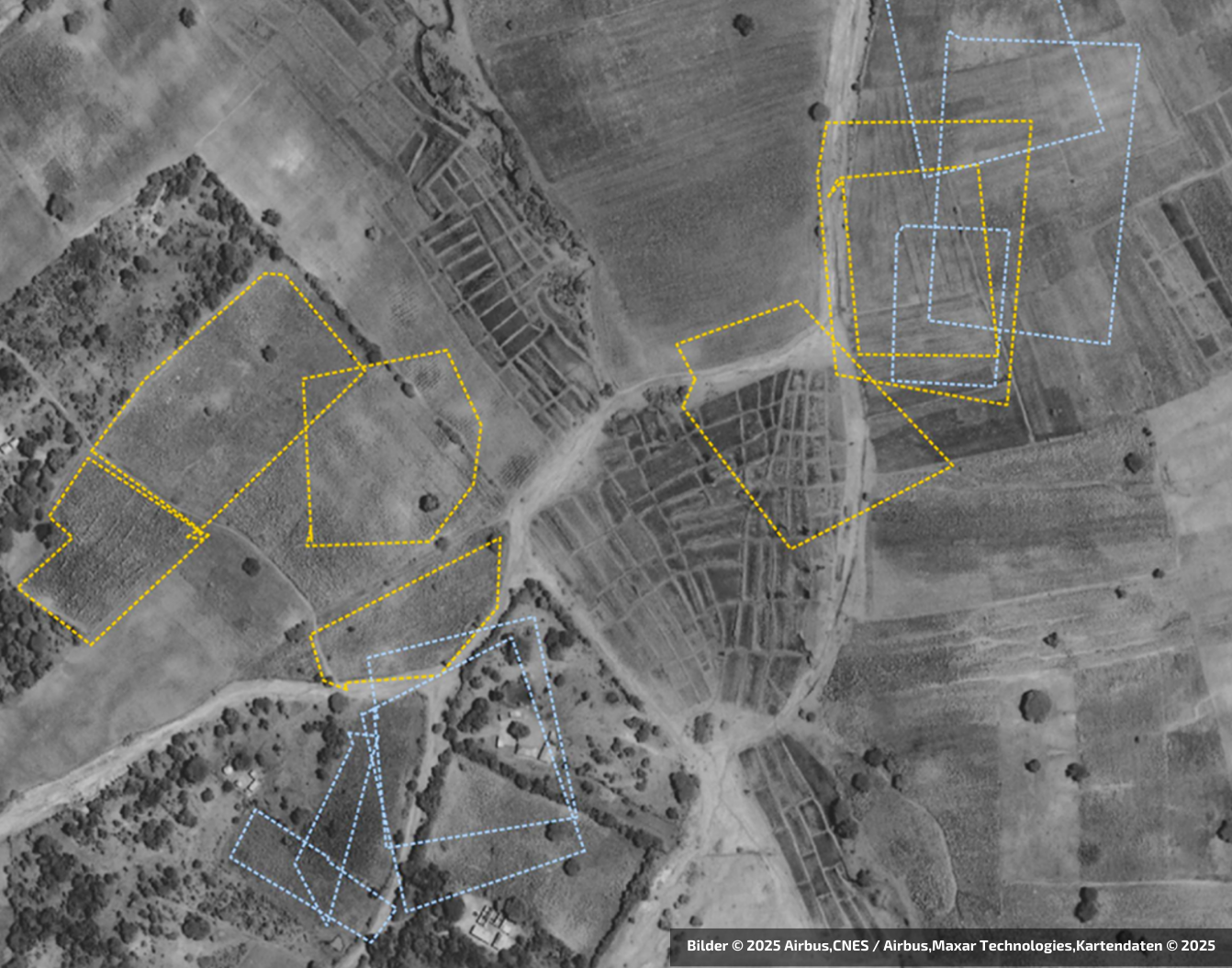
Challenge 1: Geolocation Data Is Often Less Reliable Than Expected
EUDR compliance starts with geolocation.
That sounds straightforward. In practice, it is often one of the most challenging parts of the process.
Companies receive location information from a wide range of suppliers and producers. Data may come in different formats, with varying levels of precision and quality. Coordinates may be incomplete, plot boundaries may be not comply with regulatory requirements or are just inaccurate, or farm polygons may overlap with neighboring parcels.
As a result, organizations frequently discover that a significant share of their data requires validation, correction, or enrichment before any meaningful assessment can begin.
Low quality of the geodata is relatively easy to detect for the National Authorities und thus pose a significant risk to the company.

Challenge 2: Deforestation Assessment Is More Than a Map Overlay
Many organizations initially assume that deforestation assessment is simply a matter of comparing a farm location against a satellite-based forest map.
The reality is more complex. Audit-proof results and minimising false positives present a challenge.
Reliable assessments require consistent methodologies, high-quality input datasets, satellite imagery time series, and robust processing workflows. Different approaches can lead to different results, making transparency and consistency essential.
The key question is not only whether a parcel appears compliant today. The question is whether the assessment can be trusted, reproduced, and explained.
As EUDR implementation matures, not only producing an outcome is important, but confidence in the assessment process will become most relevant.

Challenge 3: Auditability Is the Real Test
Many projects focus on generating a compliance result.
Few focus sufficiently on defending that result.
Sooner or later, companies will need to demonstrate how a specific conclusion was reached. Auditors, customers, and authorities may ask questions such as:
- Which geolocation data was used?
- How was the parcel validated?
- Which methodology was applied?
- Which satellite and reference data supported the assessment?
- Can the result be reproduced?
Using black-box AI engines pose a challenge in that respect. Organizations that build auditability into their processes from the beginning will be in a much stronger position. Trying to reconstruct evidence later can cause issues.
A Shift From Understanding to Execution
Over the past two years, much of the discussion around EUDR has focused on understanding the regulation.
Today, the challenge is different.
Most organizations understand what they need to achieve. The focus is now shifting toward operational implementation: building scalable, reliable, and auditable processes that can support thousands of suppliers and millions of hectares.
The good news is that these challenges can be addressed successfully. But they require careful planning and the right technical foundations from the start.
The most successful EUDR projects are not necessarily the ones with the largest teams or budgets. They are the ones that establish strong foundations before implementation begins.
Because in EUDR compliance, success is often determined long before the first due diligence statement is submitted.
How we can support you
- Find out more about our EUDR-Check to conduct a successful geolocation and deforestation due diligence. Contact us for a demonstration at EUDR@geocledian.com.
- Deeper insights into our methodology: Download our Whitepaper
- To stay up to date, subscribe to our LinkedIn Newsletter!

Get in touch.
We’re here to help.
Feel free to reach out to us if you have any further
questions or inquiries.