

Parcel Sustainability Passport: Join us on our journey from prototype to market-ready product
After the South Pole carbon credit scandal in 2023, companies need solid proof for climate claims to increase credibility. Our 3C – Carbon Claims Check project delivers exactly that with the Parcel Sustainability Passport: geospatial and remote sensing analytics that verify carbon-smart farming at parcel level. 3C – Carbon Claims Check is an ESA Kick-Start on Green Claims – Feasibility Study.
3C – Carbon Claims Check and the Parcel Sustainability Passport (PSP)
The Parcel Sustainability Passport performs parcel geometry validation and confirms carbon farming practices like cover crops, crop rotation and reduced tillage, while adding historic insights and risk indicators. It supports claim validation, Soil Organic Carbon (SOC) modelling, certification, subsidies and resilient supply chains — making carbon farming measurable, scalable and trusted for project owners, insurers, brands and agribusinesses alike.
Read more below – we at Geocledian are excited to share more details! Take part in our survey and help us tailor the Parcel Sustainability Passport to your needs! In the survey you can also register for early testing!

Who can benefit from the Parcel Sustainability Passport?
- Corporate buyers in food, beverage and textiles can back up Scope 3 and ESG claims with verified farming practices.
- Enablers like project developers, FMIS providers and sustainability consultants gain a scalable way to validate carbon insetting and GHG footprint improvements.
- Standards bodies and auditors get a trusted reference layer for verification.
- Farmers profit indirectly through partners who support regenerative practices at scale.
- Banks get a detailed ESG profile of land assets for their reporting
- Governments can use it to steer or control subsidy schemes, while agricultural insurers explore it for climate-smart premiums.
Deeper insights into user requirements
The Parcel Sustainability Passport is designed to match the key needs of our user groups with concrete, usable services.
- For corporate buyers and brands, trust and credible ESG reporting are addressed through validated practice detection, transparent accuracy metrics, and auto-generated reporting that supports Scope 3, SBTi and certification requirements.
- Enablers such as project developers, FMIS providers and GHG consultants benefit from interoperable APIs, scalable multi-level monitoring, and hybrid SOC input capabilities, reducing data complexity, MRV workload and operational costs.
- Standards bodies and auditors gain reliability through permanence and additionality checks, audit-ready data trails, and standardised MRV alignment, improving verification efficiency and comparability across regions and methodologies.
- Farmers profit indirectly via advisory-relevant insights, including soil health, biodiversity proxies and productivity-related indicators—delivered through their partners without additional data burden.
- Banks ESG reporting is addressed through comprehensive sustainability indicators and automated reporting that supports the requirements of the banking supervision.
- Governments and agricultural insurers receive risk and co-benefit indicators, aggregation across farms or regions, and robust boundary validation, supporting subsidy control and emerging climate-smart incentive schemes.

Use-Case Scenarios
The Parcel Sustainability Passport addresses four concrete use-case scenarios across the full lifecycle of carbon and sustainability projects:
- Supplier sustainability assessment
Buyers and enablers can compare the sustainability status of suppliers or farmer groups down to field level. This supports sourcing decisions, farmer selection, and establishing Scope 3 or SBTN baselines before launching improvement programmes. - Project implementation & MRV enhancement
During the 3–5 year implementation phase, the Passport enriches project data, reduces MRV and field survey costs, and provides continuous farmer insights through remote monitoring and risk alerts. - Certification support
Enablers, registries and standards bodies can rely on standardised, independent information to streamline verification and support carbon credit certification. - Long-term MRV & reversal risk reduction
After project completion, buyers and enablers can maintain low-cost monitoring, detect deviations and reduce reversals risk through ongoing satellite-based tracking.
Parcel Sustainability Passport (PSP)
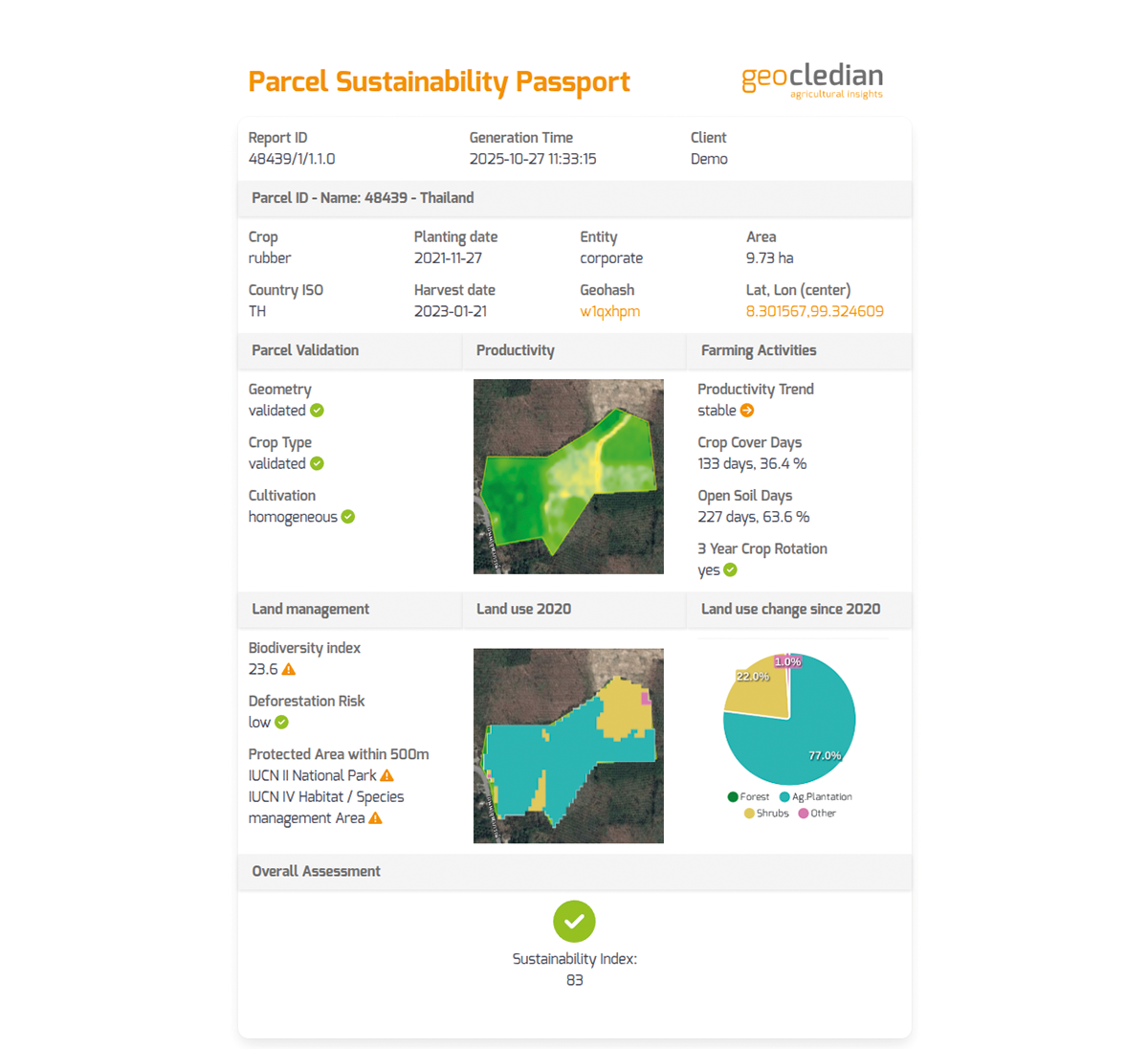
The PSP will be delivered via API – easy to use, easy to integrate in any software. It will include a range of indicators that can be visualised in a dashboard. The Passport itself will be issued in the form of an auditable parcel-based test protocol pdf report (see figure below).
We have currently defined a set of indicators or ‘markers’ such as parcel geometry validation, cover cropping, deforestation marker, biodiversity index and other (see above). We would appreciate your help in refining and/or expanding this set:
Feel free to contact us for further information: agriculture@geocledian.com
And please take part in our short survey (max. 5 minutes) – thank you very much! In the survey you can also register for early testing!

3C – Carbon Claims Check is an ESA (European Space Agency) Kick-Start on Green Claims – Feasibility Study

Get in touch.
We’re here to help.
Feel free to reach out to us if you have any further
questions or inquiries.